Welcome to the Front-end Development study-programme! We’re excited to have you joining us on this course.
Front-end Development is an exciting, new field that is quickly becoming an important role in the modern world. As businesses and organisations have started to understand the importance of having a good user experience online, so the importance of front-end development has risen.
Front-end differs from other areas of programming because of its dual-focus: code on the one hand, and design on the other. A Front-end Developer is able to understand the needs and wants of a user, and then how to use code and design to achieve those results.
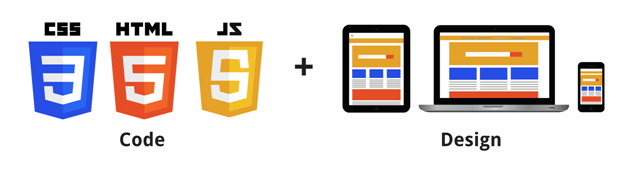
We will be giving you all the skills and building blocks you need to become a great front-end developer; able to design user-friendly websites and use HTML, CSS, and JavaScript to build them.
NOTE: This first course contains an introduction module where you will learn how to be a webstudent. We will help you go through and learn everything you need to focus 100% on your studies. Please read the text below this table, before you start on the content. It contains important information that you should be aware of.
Course assignment
Each course in the programme will have from one to several modules, and each module will have their own overview. Here it is suggested how the student should spread his/her study time across the various lessons. The times supplied for each lesson are an approximation, and could vary from student to student, and lesson to lesson.
In addition, in this first course, everything will be explained in more detail than in later courses. If you are ever unsure what something means, go back to this introduction course and read the descriptions carefully. Please make sure you read through the Important Information section on Moodle.
Course, modules and lessons
This course only contains one module, which spans for four days for full-time students, and eight days for part-time students.
The estimated time a student should be prepared to spend is around 20 hours in total - around half of a “normal” module, which is around 40 hours.
A lesson (including its assignment, if any) has an estimated workload of approximately 8 hours, but this might vary slightly. This equals one day for full-time students, and two days for part-time students. For this introduction week, the workload is set up to be slightly lower so that we are sure you will have enough time to understand everything.
Each module contains all the lessons and assignments that you should complete, a suggested schedule to help you plan your time. You may complete everything at your own pace, as long as you meet the delivery deadline for each module. The deadines are listed in your progression plan.
The time estimated each day gives you an indication on how much we are expecting from you for each task. If you are ever in doubt if you have done the task correctly, ask your tutor or fellow students, using the Discussions-feature.
If anything is unclear, check your course plan, and/or contact a tutor on the discussions.
Deliveries
The assignments tied to the lessons are normally not to be delivered (unless stated otherwise), but they might require you to participate in a discussion, to complete a quiz, or even produce material for your later module assignments.
Normally, each module will contain a module assignment. However, there are exceptions, such as if there is a course assignment in its place. This will often be the case on the last module of a course. In the case of the introduction-course, there is only one module in the course - and you are therefore taken straight to your course assignment.
Please note that all module and course assignments are to be submitted within their respective deadlines listed in your progression plan, via the LMS unless stated otherwise.
Late deliveries on a course assignment or project, will cause you to fail.
Now you can start on the lessons. Make sure you go through the lessons and assignments in order.
Extra lessons/videos
From time to time, we might link useful content in the overview that is not necessarily a part of the study plan, but is considered “very useful” and “nice to know”. This we recommend that you have a look at if you have time to spare.